
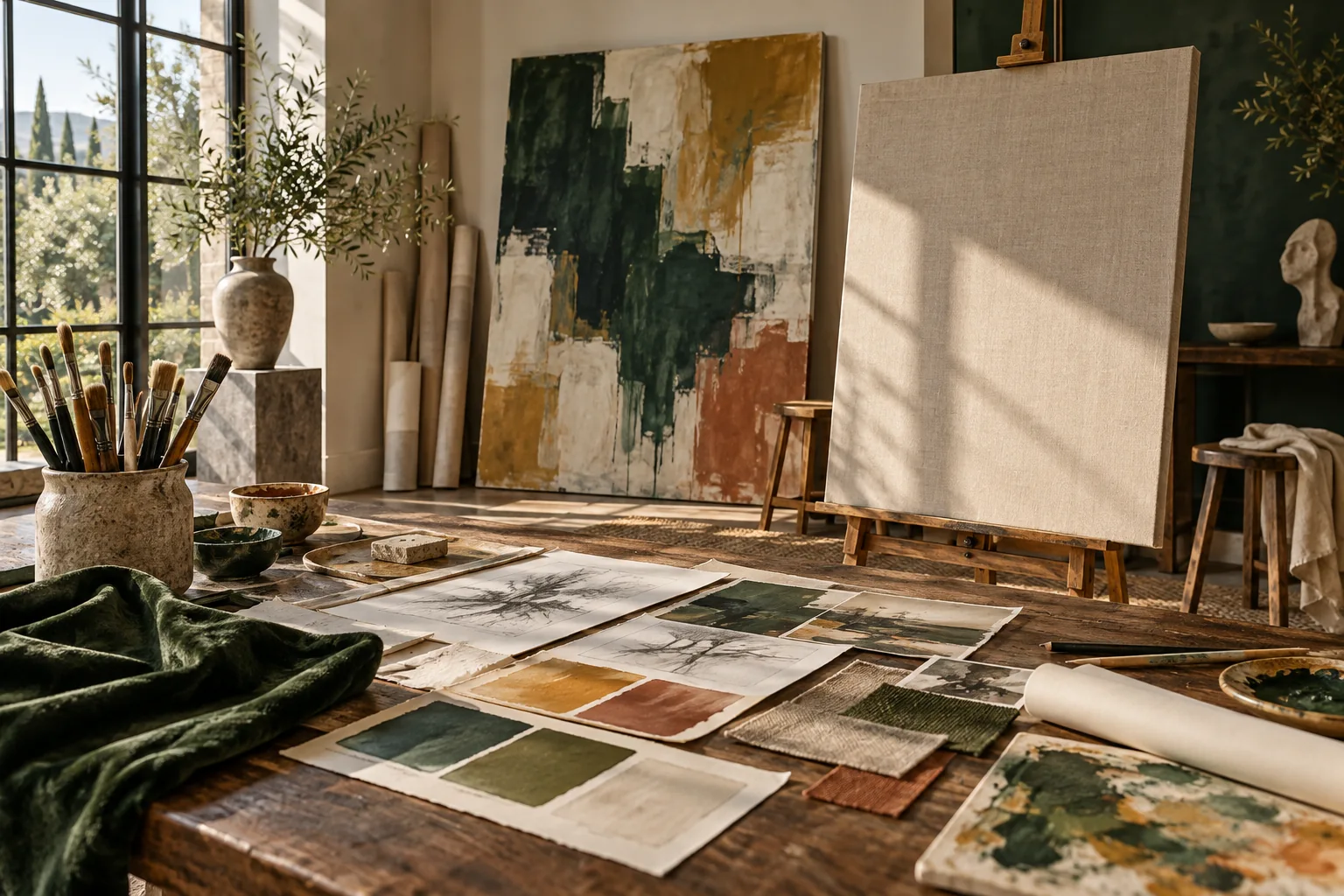
Editorial illustration of early commission planning; the paintings shown are illustrative.
A custom oil painting can begin with a person, a memory or a place in your home that calls for a particular work. Commissioning means developing a painting with an artist for a defined brief, while allowing space for the artist's own vision. The best result starts with a good conversation, realistic expectations and clear agreement about what will be created.
Begin with the reason for the painting
Tell the artist why you are considering a commission. Is it a portrait, a gift, an atmosphere you cannot find in an existing piece, or a work sized for a particular wall? Share a few images of the space and examples from the artist's own portfolio that you connect with. These references help communicate mood and priorities; they are not a request to copy another person's artwork.
You do not need to arrive with a complete composition. A concise brief can cover the subject, approximate dimensions, preferred orientation, colour considerations, where the piece will live and any date that truly matters. Leave room to discuss what is feasible in the artist's practice.
What to discuss before work begins
Scope: subject, medium, support and approximate size.
References: photographs or visual ideas, and permission to use any supplied imagery.
Process: what stages of discussion or preview will be offered, and how feedback will be handled.
Timing: an estimated schedule that accounts for painting, drying, framing and delivery.
Cost and terms: the quoted price, deposit or payment stages, shipping and any agreed changes.
Oil painting takes time to develop and may need additional drying time before a work can be framed, packed or shipped. Timing varies with technique and the particular painting; ask for a specific estimate instead of assuming every commission can follow the same timetable.
See Shima's existing oil-on-canvas work Spirit of Freedom to get a sense of the artist's practice; this is an existing painting, not a sample commission.
How much creative direction should you give?
Be precise about the details that matter to you and open about the rest. If the subject must include a particular person, object or colour, say so early. If your interest is in the artist's brushwork or a feeling found in earlier pieces, describe what draws you to that work. Discuss in advance how any proposed changes will be reviewed. A commission is a collaboration, but it is still an original work by the artist.
Consider scale, framing and delivery together
Measure the wall and photograph it from the distance at which you usually see it. Talk about whether the painting should be presented on stretched canvas, in a frame or in another format suitable for the work. The final outside frame dimensions may differ from the canvas size. For a destination outside Sydney, discuss delivery and packaging as part of the brief rather than an afterthought. You can read our oil painting framing guide before making that decision.
Start the conversation
If you are still discovering the direction, explore the available original paintings first. Existing work can help you find the subjects, colours and surfaces that stay with you. When you are ready to describe your own idea, visit Shima Lumen Gallery's commissions page to begin an enquiry. A clear brief gives the painting a strong beginning; trust in the artist's eye gives it space to become something personal.